DexMani: Human-Derived Manipulability Guidance for Dexterous Rotation

Xiaoyang Chen1,2,3*, Shengcheng Luo2,3*, Haoran Guo2, Jiaming Jiang2,3, Wanlin Li3, Ziyuan Jiao3,4†, Chenxi Xiao2†

1 Shanghai Jiao Tong University 2 ShanghaiTech University 3 Beijing Institute for General Artificial Intelligence (BIGAI) 4 Beihang University

* Equal contribution Corresponding authors

Project Overview

Abstract

Dexterous object rotation requires a robot hand to repeatedly release and remake contacts without dropping the object or stopping the rotation. We introduce DexMani, a demonstration-guided reinforcement learning framework that transfers contact-transition knowledge across hand morphologies. Rather than retargeting human poses, trajectories, or contact identities, DexMani learns how contact-conditioned rotational manipulability changes during successful human rotation. During robot training, each candidate action is evaluated using the target hand's own kinematics and active contacts, and a frozen energy prior provides residual action guidance. We evaluate DexMani on cap unscrewing, free object rotation, faucet turning, cross-hand cap twisting, and closed-loop real-robot deployment.

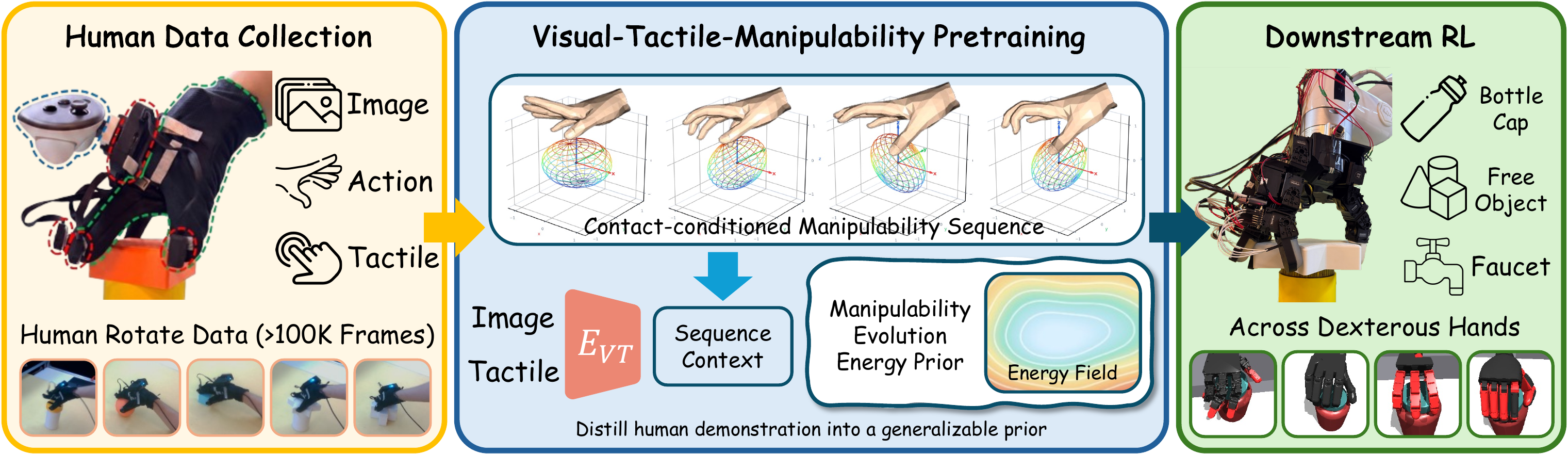
DexMani overview from human rotation data to manipulability guidance and downstream reinforcement learning
Overview. Human rotation demonstrations are distilled into a prior over contact-conditioned manipulability evolution. The frozen prior then guides reinforcement learning across rotation tasks and dexterous hand embodiments.

Method

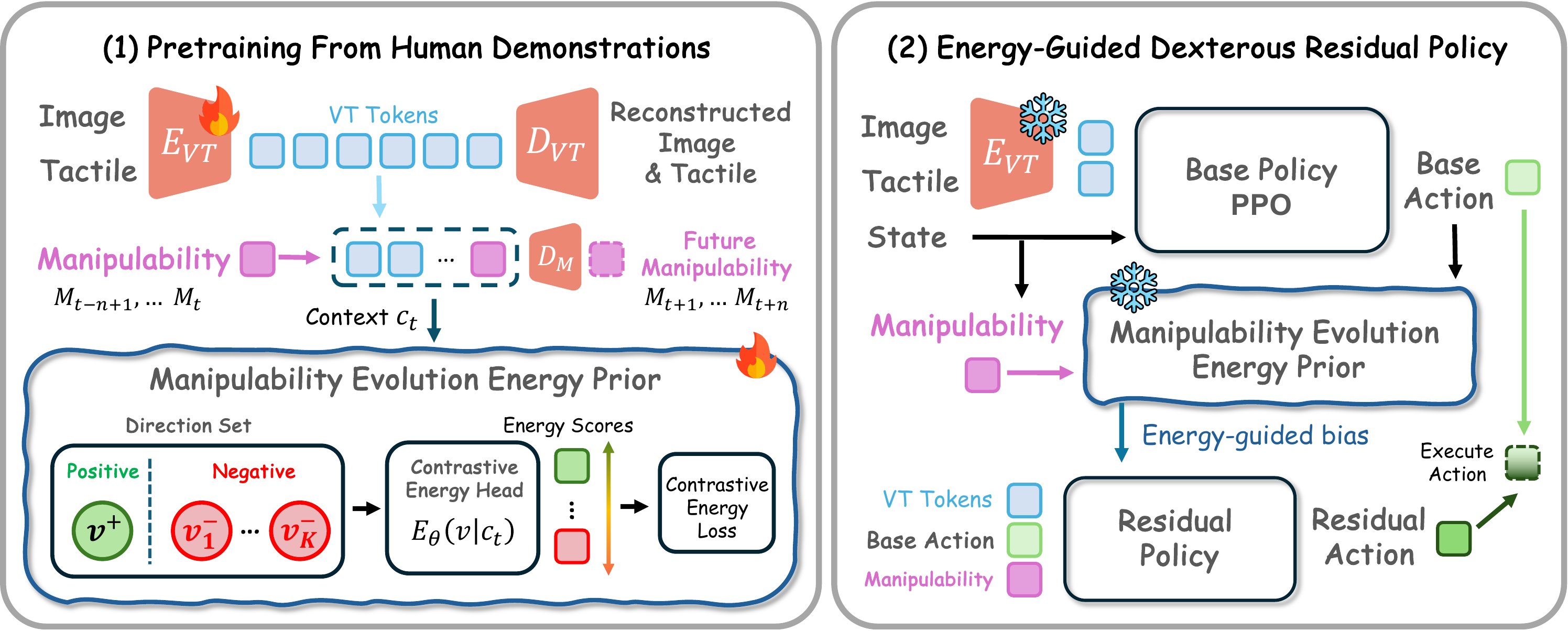
DexMani transfers contact-transition knowledge without retargeting human joint motion. It first learns an energy prior over contact-conditioned manipulability evolution from human visual-tactile demonstrations. During robot reinforcement learning, each candidate action is interpreted through the robot's own kinematics and active contacts, and the frozen prior supplies an energy-guided residual signal in the native action space.

DexMani pretraining from human demonstrations and energy-guided residual policy
DexMani pipeline. Human demonstrations supervise a manipulability-evolution energy prior; the frozen prior then guides the residual robot policy without reward shaping.
01

Multimodal
demonstrations

RGB observations, finger pose, global hand pose, and a tactile pressure array are synchronized during human rotation. These signals identify active contacts without treating human joint trajectories as robot references.
02

Manipulability
evolution prior

Contact-aware hand kinematics yield a rotational manipulability descriptor at each time step. A contrastive energy model learns which short-horizon changes match successful human contact transitions.

03

Energy-guided
residual policy

The robot maps candidate actions to changes in its own manipulability. The frozen prior prefers low-energy candidates and supplies a local residual hint, while the policy is optimized only with the task reward.

Human Data Collection

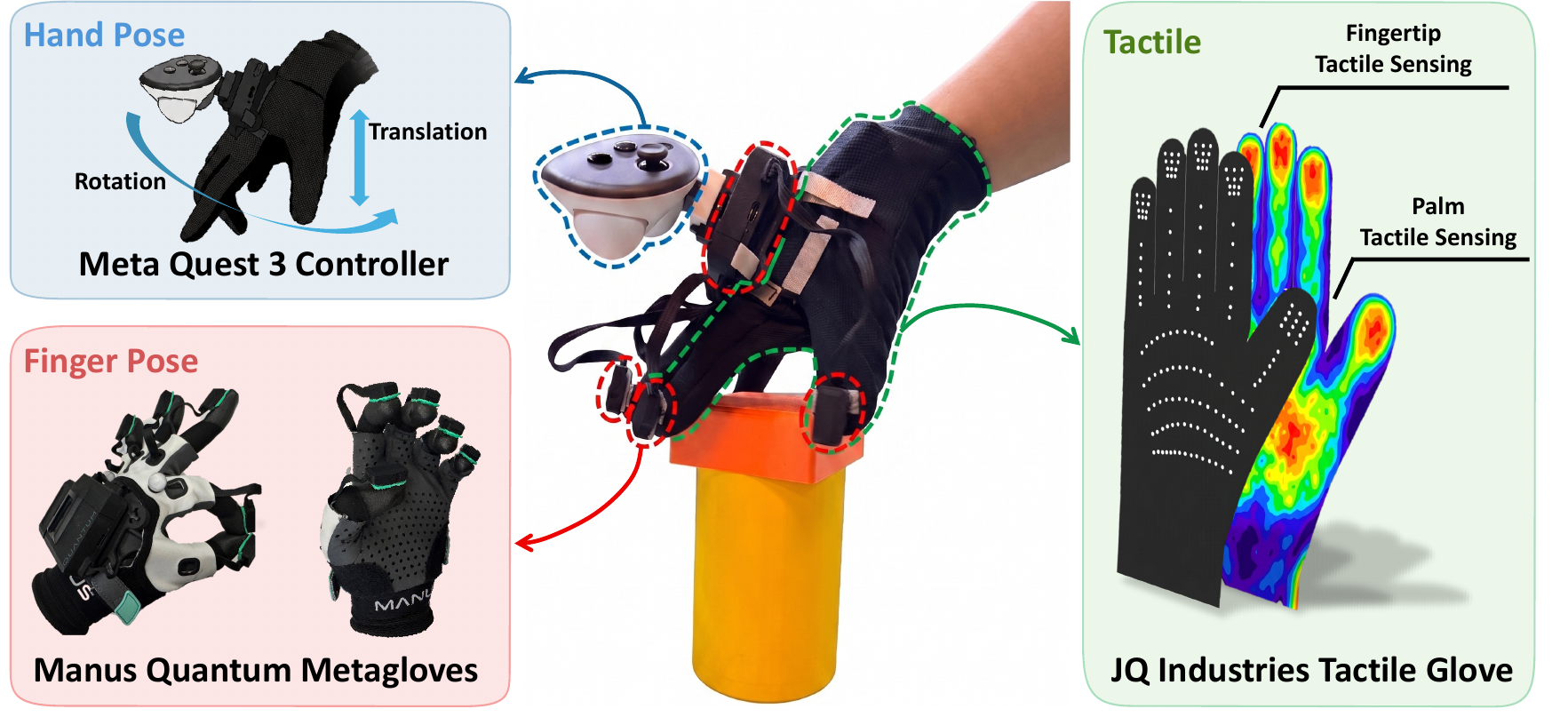
High-quality robot demonstrations are difficult to obtain for fast, contact-rich rotation, so we collect demonstrations directly from human participants. Synchronized RGB, hand pose, finger pose, and tactile pressure identify active contacts across more than 100,000 frames; human motions are never retargeted as robot actions.

Human data collection system with pose and tactile sensing
Multimodal human-rotation collection. A Meta Quest 3 controller tracks global hand pose, a Manus Quantum MetaGlove captures finger joint pose, and a JQ Industries tactile glove records contact pressure. Together with RGB observations, these signals identify active contacts and compute contact-conditioned manipulability labels.
Objects used for human rotation demonstrations
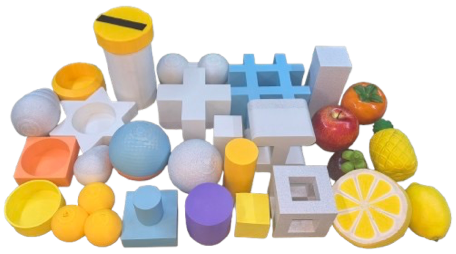
Object diversity in human data collection. Representative objects span varied shapes and contact geometries, exposing DexMani to diverse contact-rich rotation behaviors.

Human Demonstration Videos

Three multimodal human rotation demonstrations used to learn the contact-conditioned manipulability prior.

Experimental Results

A single frozen human-derived prior is reused across three LEAP-hand rotation tasks. DexMani achieves the highest mean success rate in all six seen/unseen settings, including faucet turning, which is held out from human-prior pretraining.

Method Unscrew Cap Rotate Object Turn Faucet Avg.
SeenUnseen SeenUnseen SeenUnseen
PPO11.8 ± 2.15.0 ± 1.926.5 ± 0.721.5 ± 0.633.2 ± 3.520.5 ± 1.019.8
VT Pretraining29.0 ± 1.512.7 ± 3.142.6 ± 1.434.0 ± 4.662.4 ± 4.753.5 ± 4.839.0
VTM47.0 ± 0.927.8 ± 1.849.5 ± 3.037.9 ± 3.479.0 ± 1.270.1 ± 3.251.9
VTA40.1 ± 0.825.1 ± 1.737.4 ± 5.820.3 ± 1.877.2 ± 2.263.5 ± 7.743.9
VTA-E24.2 ± 2.011.6 ± 3.629.0 ± 6.319.1 ± 3.067.6 ± 1.942.0 ± 5.132.3
DexMani65.1 ± 2.439.3 ± 2.550.7 ± 2.239.2 ± 3.180.2 ± 2.070.3 ± 2.957.5

Table 1: Guidance reuse across tasks and object generalization. Each task-split value is mean ± standard deviation of success rate (%) across three independent seeds. Avg. SR is the mean of the six task-split means.

LEAP Hand Task Videos

DexMani executions across the three LEAP Hand rotation tasks.

Unscrew Cap

LEAP Hand

Rotate Object

LEAP Hand

Turn Faucet

LEAP Hand

Cross-Hand Cap Unscrewing

The same frozen human-derived prior is reused across the Shadow, Allegro, and XHand platforms. A separate policy is trained in each hand-specific action space.

Method Shadow Hand Allegro Hand XHand Avg. SR
SeenUnseen SeenUnseen SeenUnseen
PPO20.8 ± 2.66.8 ± 2.611.8 ± 1.65.2 ± 2.432.5 ± 3.317.2 ± 1.615.7
VTM66.4 ± 4.440.9 ± 9.224.3 ± 3.912.5 ± 4.258.0 ± 1.422.7 ± 8.437.5
VTA-E52.7 ± 3.224.5 ± 6.717.6 ± 3.59.8 ± 1.745.2 ± 2.818.2 ± 7.528.0
DexMani70.0 ± 3.148.2 ± 4.834.6 ± 4.014.8 ± 2.363.4 ± 4.529.5 ± 1.943.4

Table 2: Cross-hand cap-unscrewing transfer. Each hand/setting value is mean ± standard deviation of success rate (%) across three seeds. Avg. SR is the mean of the six hand/split means.

Cross-Hand Videos

Cap-unscrewing executions using the same frozen human-derived prior across three hand embodiments.

Shadow Hand

Unscrew Cap

Allegro Hand

Unscrew Cap

XHand

Unscrew Cap

Mechanism Ablation

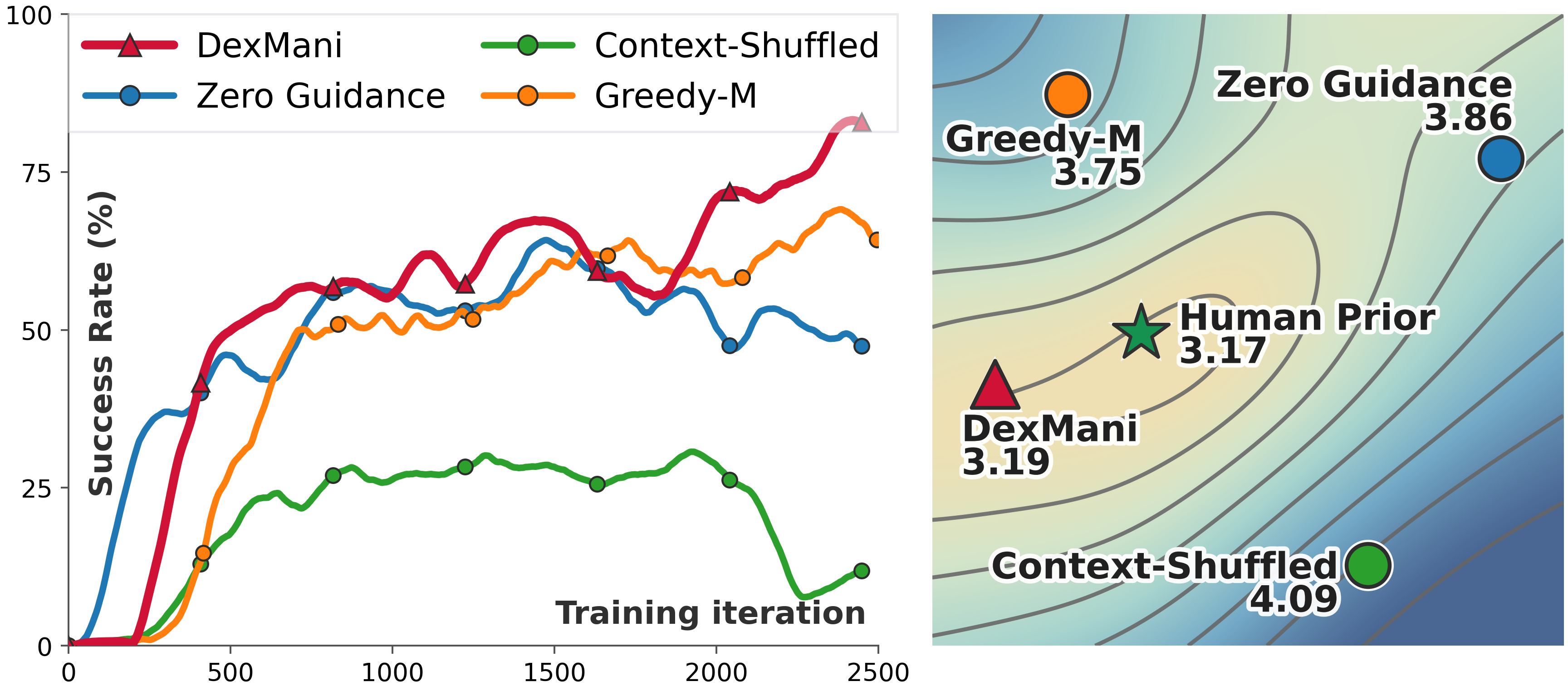
The controlled variants keep the same training setup and differ only in their guidance signal. DexMani uses state-aligned, short-horizon manipulability-evolution guidance.

Learning curve and action energy landscape
Mechanism analysis. DexMani learns faster and selects low-energy actions that align with the learned human prior.
Method Unscrew Cap Turn Faucet Avg. SR
SeenUnseen SeenUnseen
Zero Guidance18.69.448.620.224.2
Context-Shuffled14.05.322.57.312.3
Greedy-M54.536.367.844.750.8
DexMani65.139.380.270.363.7

Table 3: Mechanism ablation. Values are mean success rate (%). The final manuscript reports means, but not standard deviations, for this controlled ablation.

Execution Quality and Smoothness

We measure task-aligned rotational capability with TCI and motion smoothness with log dimensionless jerk (LDLJ) and spectral arc length (SPARC). Higher values indicate better performance for all three metrics.

Method Unscrew Cap Rotate Object Turn Faucet
TCI ↑LDLJ ↑SPARC ↑ TCI ↑LDLJ ↑SPARC ↑ TCI ↑LDLJ ↑SPARC ↑
PPO0.29 ± 0.11-25.6 ± 1.4-6.0 ± 0.50.43 ± 0.11-14.5 ± 0.1-2.6 ± 0.20.22 ± 0.05-23.2 ± 2.3-4.8 ± 0.8
VT Pretrain0.41 ± 0.13-24.5 ± 1.1-5.5 ± 0.60.41 ± 0.23-14.4 ± 0.1-2.8 ± 0.20.23 ± 0.06-23.2 ± 2.0-4.5 ± 0.9
VTM0.44 ± 0.17-24.1 ± 0.8-5.3 ± 0.70.26 ± 0.18-15.5 ± 0.8-3.3 ± 0.30.27 ± 0.15-23.4 ± 1.8-4.4 ± 0.4
VTA0.45 ± 0.12-23.7 ± 1.6-5.0 ± 0.10.29 ± 0.09-15.6 ± 0.9-3.1 ± 0.20.23 ± 0.04-23.9 ± 2.4-4.1 ± 1.2
VTA-E0.43 ± 0.05-23.6 ± 0.4-5.0 ± 0.30.23 ± 0.10-13.9 ± 0.2-2.8 ± 0.50.20 ± 0.02-24.8 ± 0.4-4.5 ± 0.8
DexMani0.50 ± 0.13-23.1 ± 0.5-4.5 ± 0.40.36 ± 0.05-11.9 ± 1.8-2.3 ± 0.70.28 ± 0.07-22.4 ± 0.5-3.9 ± 0.1

Table 4: Quantitative comparison of execution quality and efficiency. Every entry is reported as mean ± standard deviation; the columns span three dexterous rotation tasks on the LEAP hand.

Real-World Deployment

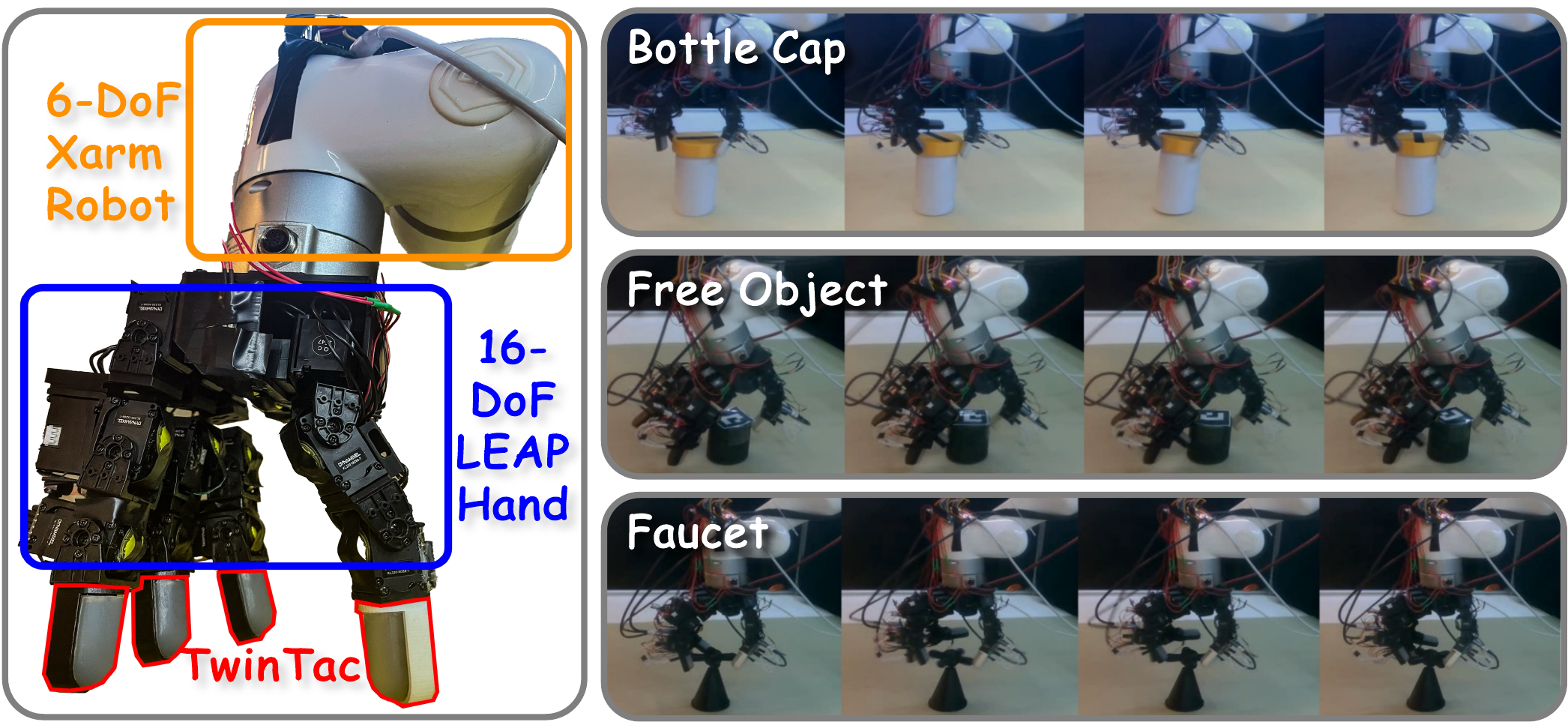
Physical LEAP Hand on xArm executing dexterous rotation
Closed-loop hardware demonstration. A 16-DoF LEAP Hand is mounted on a 6-DoF xArm and controlled at 20 Hz with visual, tactile, and proprioceptive observations.

We deploy DexMani on a physical LEAP Hand with TwinTac tactile sensors. The policy receives binarized tactile input and predicts joint-position targets online.

Unscrew Cap
6 / 10
Rotate Object
3 / 10
Turn Faucet
1 / 10

These experiments establish qualitative closed-loop feasibility under sensing and dynamics mismatch; they are not presented as a new sim-to-real benchmark.

Successful Real-World Videos

Select a task to view its successful closed-loop execution on the physical LEAP Hand. All actions are displayed at the original speed, at a frequency of 20 Hz.